Enterprise analytics agents need a shared understanding of the business: what a measure means, which data supports it, how relationships affect its results, and which reports depend on it. That understanding must survive beyond a single conversation. On top of that there could be databases, datalakes and data warehouses that handle data transformations will also need to be part of that conversation.
A semantic model makes the definitions executable. Lineage records dependencies. A enterprise BI Brain or a Database with enterprise memory or a typeical a knowledge graph can connect those facts. Specialized agents can then build models, inspect changes, run validation, and produce reports against the same versioned foundation.
This article presents an implementation framework for that architecture. Ihe article shares a typical data modelling and interaction of agents with native and normalized metadata, scoped graph traversal, controlled model editing, platform-specific validation bots, typed report tools, and persisted analysis results. The contracts and examples below are illustrative designs readers can adapt; the proposed specialist roles do not imply that every role already exists as a separate agent.
The running example is a regional sales report. A user/team wants to reuse an existing sales definition in a new semantic model, compare September and October, and explain which regions contributed to the change. The implementation must preserve business meaning, reconcile results, and show the evidence behind the report
The architecture: shared context, controlled execution, durable evidence
Give each part of the system a clear responsibility.
| Component | Responsibility | Principal output |
|---|---|---|
| Source adapters | Extract model metadata, expressions, report bindings, and source references | Versioned source inventory |
| Knowledge graph | Connect business concepts, model objects, source dependencies, and report artifacts | Scoped, traceable context |
| Semantic model | Execute approved measures, relationships, and filter rules | Consistent analytical results |
| Orchestrator | Resolve scope, sequence tasks, enforce permissions, and collect outcomes | A tracked workflow |
| Specialist agents | Perform bounded modeling, lineage, validation, or reporting tasks | Proposed changes or evidence |
| Execution services | Run authorized queries and deterministic checks | Persisted validation results |
| Artifact store | Retain model revisions, report definitions, snapshots, and run evidence | Reproducible review packages |
The graph holds metadata and meaning. Business data remains in the governed source systems and analytical engines. Retain result evidence according to its sensitivity and retention requirements; a metadata graph does not require copying transaction records into it.
The following diagram shows the intended flow. The arrows represent processing and references, rather than a particular graph edge schema.
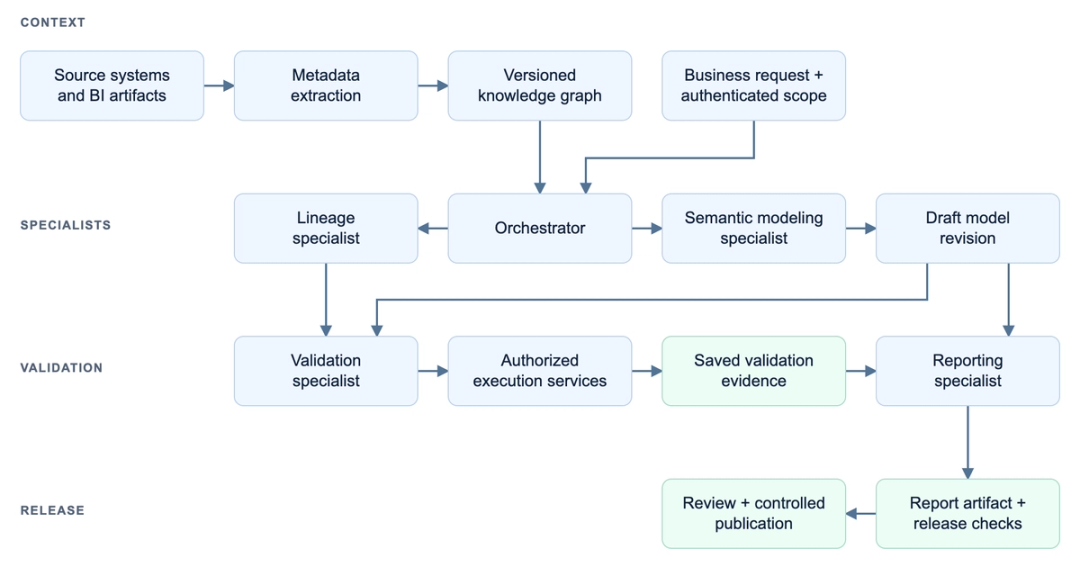
Architecture flow: from request to reviewed evidence
- Extract metadata from source systems and BI artifacts into a versioned knowledge graph.
- Give the orchestrator the business request, authenticated scope and graph context.
- Retrieve lineage context and propose a draft semantic model revision.
- Run authorized validation services and save the resulting evidence.
- Build the report from the draft model and saved validation evidence.
- Review the report artifact and release checks before controlled publication.
Data boundary: business data remains in governed source systems and analytical engines.
Build the framework in eight stages. Each stage should produce an artifact another person or service can inspect.
1. Define one business domain and inventory its assets
Begin with a bounded outcome: “Create a monthly regional net-sales report using the approved finance definition.” Identify the domain owner, intended audience, source systems, target platform, and required comparison period before an agent edits anything.
For the sales example, the first deliverables are one model, an approved sales measure with comparison calculations, a regional comparison page, and a reconciliation suite. An analyst owns the business definition; an analytics engineer owns the model; a reviewer accepts the evidence.
Create a source manifest with these fields:
| Field | Example or purpose |
|---|---|
| Asset identity | Stable identifier for the original workbook, model, or dataset |
| Platform and container | Source platform and authorized workspace or project |
| Source revision | Export hash or source version, with capture time |
| Objects discovered | Tables, columns, measures, relationships, pages, and visuals |
| Extraction coverage | Parsed, unsupported, missing, or inaccessible objects |
| Business ownership | Owner responsible for approving meaning |
| Execution connection | Reference to an explicitly attached connection; no credentials |
Use identities that remain distinct across workspaces and platforms. A display name such as Sales is insufficient. Prefer a source object ID within an authorized container. When a platform provides no stable identifier, maintain a mapping registry and an explicit rename process instead of assuming names are permanent identities.
Completion gate: every in-scope object is either represented or listed as an extraction exception. The inventory has an owner and an identifiable source revision.
2. Build a repository or graph that preserves native semantics
Metadata layers and their boundaries
- Native metadata: preserve expressions, data types, relationship direction, filters and visual bindings.
- Normalized metadata: connect common assets, fields, formulas and mappings to their native identities.
- Semantic contract: record definition, owner, grain, units, dates, exclusions and approval.
- Separate agent memory: keep preferences and earlier suggestions distinct from approved definitions and BI lineage.
A useful analytics graph needs both platform detail and a common way to compare assets.
The native layer preserves objects as their platform understands them: tables, columns, measures, relationships, partitions, worksheets, filters, report pages, and visual bindings. Preserve expression language, data type, aggregation, relationship cardinality, filter direction, and relevant platform settings.
The normalized layer provides common concepts for discovery and comparison across platforms: assets, fields, formulas, and mappings. Each normalized object links back to its native representation. A common label must not erase a platform-specific calculation or filtering rule.
A shared inventory can support comparison while retaining the original model needed for interpretation and export.
Start with a small graph contract:
| Entity or relationship | What it records |
|---|---|
| Business metric | Approved definition, owner, version, unit, and grain |
| Model object | Native table, field, measure, relationship, or calculation |
| Source object | Physical table, column, query, or transformation reference |
| Report object | Report, page, visual, binding, and filter |
| IMPLEMENTS | A model measure implements a business metric |
| DEPENDS_ON | An object relies on another object |
| DERIVED_FROM | A transformation or field traces to a source object |
| BINDS_TO | A visual refers to a specific measure or field |
| SUGGESTED_MAPS_TO | A proposed correspondence awaiting review |
| MAPS_TO | An approved correspondence with recorded evidence |
These are reference-schema names, not a required API vocabulary. Existing platform adapters may expose more specific relationships such as USES_COLUMN or USES_FIELD.
For every dependency, record how it was established: parser output, platform metadata, or reviewer confirmation. Include the source revision and extraction method. A confidence score can help prioritize review, but it does not establish correctness.
Treat re-ingestion as a versioned operation. Upsert known identities, detect changes through fingerprints, and reconcile deletions only after a complete authorized inventory. A failed or partial scan must not delete objects that were simply unavailable. Publish the resulting graph revision only when ingestion finishes, so agents cannot read a mixture of old and new metadata.
Keep agent memory separate from this model. A remembered preference or an earlier suggestion is a different kind of information from an approved measure definition.The memory projection and BI asset lineage use separate graph structures and agents should preserve that boundary in their own implementation.
Completion gate: an engineer can trace a model object back to its source representation, distinguish proposed mappings from approved ones, and identify incomplete extraction.
3. Turn business definitions into semantic contracts
A graph tells an agent which objects are connected. The semantic contract explains what those connections mean for analysis.
For each shared measure, document the business definition, row grain, aggregation, dates, units, exclusions, null behavior, relationship assumptions, and approval status. Store this contract as a versioned artifact referenced by the graph.
For the sales example:
metric_id: net_sales_usd
version: "1.0"
status: approved
owner: finance_analytics
business_definition: Sales after discounts, excluding tax, net of returns
source_grain: One posted sale or return line
value_column: Sales.signed_net_amount_usd
value_rules:
  sale: Positive amount after discounts, excluding tax
  return: Negative amount after discounts, excluding tax
  currency: USD using the finance-approved posting-date FX rate
aggregation: Sum
reporting_date: Sales.posting_date
calendar: Calendar month in UTC
period_boundary: Inclusive start, exclusive end
allowed_dimensions:
  - Region.region_name
  - Calendar.month_start
null_amount_policy: Fail validation; do not silently treat as zero
unmatched_region_policy: Include in an explicit Unknown bucket and flag
comparison:
  delta: Current period minus prior period
  percent_change: Delta divided by prior period
  nonpositive_prior: Return null and explain
The example assumes the source preparation already applies the approved discount, tax, return, and FX rules. The agent must verify that assumption against the source transformation. It cannot infer it from signed_net_amount_usd alone.
The model then needs explicit relationships. Region.region_key is unique and filters many rows in Sales.region_key. Calendar.date is unique and filters Sales.posting_date. Check key uniqueness, unmatched keys, and the intended filter direction using data as well as metadata.
Under that contract, a Power BI implementation could use:
Net Sales USD = SUM(Sales[signed_net_amount_usd])The expression is short because the surrounding contract carries much of the business logic. An implementation using another engine must preserve the same meaning, including the grain and filter behavior.
Completion gate: the business owner approves the definition, the model represents its assumptions, and a validation suite can distinguish correct behavior from plausible alternatives.
4. Use lineage to retrieve context and assess change
Lineage flow: trace a value to its source
- The Regional Sales visual binds to the Net Sales USD measure.
- The measure implements the net_sales_usd v1.0 contract and depends on Sales.signed_net_amount_usd.
- The amount column is derived from the finance posting transformation.
- The transformation is derived from source sale and return amounts.
Read upstream to understand a value and downstream to assess change impact. Include region and date relationships, filters and security context alongside formula references.
Lineage connects the semantic contract to both its inputs and its consumers. Define the direction of each relationship consistently so upstream and downstream queries have an unambiguous meaning.
For example:
Regional Sales visual
  BINDS_TO -> Net Sales USD measure
    IMPLEMENTS -> net_sales_usd contract v1.0
    DEPENDS_ON -> Sales.signed_net_amount_usd
      DERIVED_FROM -> finance posting transformation
        DERIVED_FROM -> source sale and return amounts
The visual also binds to Region.region_name. Its totals depend on the region relationship, date relationship, filters, and security context. A dependency extractor that finds only formula column references will miss some of that context.
Maintain three views of lineage:
| View | Question it answers |
|---|---|
| Source lineage | Which source fields and transformations feed this value? |
| Semantic dependency lineage | Which measures, relationships, filters, and parameters affect it? |
| Consumption lineage | Which visuals, reports, or downstream artifacts use it? |
Before a modeling task, retrieve the relevant object, its upstream dependencies, its downstream consumers, and its contract. Return a bounded context package with the graph revision, included object IDs, extraction limitations, and any traversal truncation.
A practical traversal service should authorize the requested roots, enforce permitted scope at each hop, and restrict relationship types, depth, node count, and edge count. Model or job IDs provide partitioning; the surrounding API must still establish which partitions the authenticated caller can access.
If the amount column changes, downstream lineage identifies which measures, visuals, and validation suites need attention. If a relationship changes, impact may extend beyond direct formula references, so include relationship dependencies and model-level checks.
Use lineage to select work, while preserving its coverage limits. A truncated traversal or unsupported expression prevents a complete impact claim. Expand the inspection or route the unresolved portion for review.
Completion gate: a proposed change produces an impact list with the source graph revision and known coverage gaps. Required dependencies are resolved before the affected artifacts are released.
5. Orchestrate specialist agents through explicit contracts
Specialization is useful when it creates a meaningful boundary in context, tools, or responsibility. Start with a coordinator and a validation specialist; separate other roles as their work becomes substantial.
| Role | Assigned task | Allowed operations | Required output |
|---|---|---|---|
| Discovery and lineage | Find relevant assets and affected consumers | Scoped metadata and graph reads | Evidence-linked context and impact list |
| Semantic modeling | Implement an approved definition | Read metadata; propose or apply authorized draft edits | Model diff and resulting revision |
| Validation | Execute agreed checks | Read attached connection context; submit suites; fetch results | Run IDs and per-check evidence |
| Reporting | Build a report from model references | Inspect capabilities; edit report drafts; validate bindings | Report artifact and validation findings |
| Coordinator | Manage dependencies and resolve missing information | Delegate tasks; track state; enforce release rules | Review package and unresolved issues |
A typical report validation separates platform validation and refresh bots, with tool allowlists and explicitly attached connections. A Report authoring can also made available through typed agent tools. The reporting-specialist role or skills can use a reusable design choice.
Give each task a bounded contract. For example:
{
  "task_id": "validate-sales-r17",
  "role": "data_validation",
  "model_revision": "sales-r17",
  "metric_contract_version": "net_sales_usd:1.0",
  "suite_id": "regional-monthly-sales-v3",
  "source_connection_ref": "finance-readonly",
  "target_connection_ref": "sales-test-model",
  "period": {"start": "2026-09-01", "end_exclusive": "2026-11-01"},
  "allowed_actions": ["submit_validation", "read_validation_result"],
  "required_outputs": ["run_id", "outcome", "failed_checks", "evidence_refs"]
}
The runtime supplies authenticated user and workspace context. It also verifies connection access and enforces the action allowlist. Neither an agent-supplied role name nor a model-generated scope identifier grants permission.
Require the validation agent to return missing information when bindings, filters, or source selection are absent. It should not choose a convenient comparison database or retrieve credentials from an unrelated environment.
Manage the workflow as persisted state: draft, checking, changes required, ready for review, and released. Use task IDs and idempotency keys to avoid duplicate jobs. Submit a validation run once, retain its run ID, and resume from saved status after interruption. Keep execution status separate from validation outcome: a completed job can contain failed checks.
Parallelize independent reads or tests against the same frozen revision. Serialize dependent edits, and require an expected revision when applying a change. If another task changed the model, refresh context and resolve the conflict before proceeding.
Retrieved descriptions, uploaded files, and saved findings are input data. They must not redefine the agent’s permissions or instructions. Enforce restricted tools and authorization outside the model; this follows OWASP’s guidance on indirect prompt injection and least privilege. OWASP prompt injection guidance.
Completion gate: every specialist has an explicit scope, enforceable tool permissions, a bounded task, and a persistent output. Agreement between agents never substitutes for execution evidence.
6. Validate in layers and retain the evidence
Validation flow: retain failures and test the corrected revision
- Prepare draft sales-r17 with the approved contract and explicitly attached sources.
- Verify that the execution target contains the intended model revision.
- Run structure, reference, engine, semantic, reconciliation, report and access checks.
- Record validation-204 as failed: expected USD 900,000; observed USD 940,000.
- Correct the model, create sales-r18 and rerun impacted checks while preserving the failed run.
- Retain the passing validation-205 evidence, prepare the report draft and submit it for review.
Evidence rule: missing or inconclusive evidence prevents the corresponding correctness claim. These run IDs and values are illustrative.
A successful query establishes that an engine executed a request. It leaves other questions open: whether the expression represents the approved definition, whether the intended model revision was queried, and whether the report presents the result correctly.
Use a validation matrix with separate outcomes:
| Layer | What to check | Evidence to retain |
|---|---|---|
| Structure | Types, identifiers, expressions, relationships, and required metadata | Object paths and schema findings |
| References | Every measure, column, table, and report binding resolves | Resolved IDs and missing-reference errors |
| Engine execution | Expressions compile and execute in the intended platform | Engine response, query, dataset identity, and revision linkage |
| Semantic behavior | Grain, filters, dates, units, aggregation, and edge cases match the contract | Expected and observed results for named scenarios |
| Data reconciliation | Approved source and target return matching results at the same grain | Comparison run, keys, variances, and completeness |
| Report behavior | Bindings, filters, interactions, layout, and rendering are correct | Artifact checks and rendered inspection results |
| Access | Authorized audiences see the intended rows and objects | Positive and negative identity tests |
Report passed, failed, not_run, or inconclusive for each required check, with the reason. A platform outage produces an execution limitation. It must not become a successful validation because an earlier syntax check passed.
Bind validation to the model actually tested
The migration code makes a particularly useful distinction: an engine check against a published dataset does not certify a different, unpublished workspace model.
Carry both the draft revision and execution target identity through the validation record. Before attributing an engine result to sales-r17, establish that the test dataset contains that revision. If the platform does not expose a directly comparable revision, record the controlled deployment and verify its exported metadata fingerprint. Otherwise, label the check as applying only to the identified published dataset.
A recommended evidence envelope is:
run_id: validation-204
execution_status: complete
outcome: failed
model_revision: sales-r17
metric_contract_version: net_sales_usd:1.0
suite_version: regional-monthly-sales-v3
execution_target:
  dataset_ref: sales-test-model
  verified_model_revision: sales-r17
checks:
  structure: passed
  references: passed
  engine_execution: passed
  source_reconciliation: failed
failed_checks:
  - id: returns-included
    expected_usd: 900000
    observed_usd: 940000
    evidence_ref: validation-204/checks/returns-included
This synthetic failure identifies a target that excluded returns. The workflow should inspect the failed check, correct the affected transformation or measure, create a new revision, and rerun the impacted suite. It should preserve the failed run and its evidence.
Make comparisons equivalent before judging their results
For the regional sales comparison, align source and target on:
- The same posting period, source snapshot or watermark, and refresh state.
- The same USD conversion, return treatment, and tax exclusions.
- The same region-and-month grain and filters.
- An explicit key such as
(month_start, region_key), with duplicate-key detection. - Matching field types and projection order where the comparison API requires it.
- Defined null, rounding, missing-row, and unexpected-row behavior.
A metadata export is insufficient for a live data comparison. The validator needs explicitly selected execution sources. Likewise, a preview of a spreadsheet or a truncated query cannot establish that full results reconcile.
Define tolerance semantics before running the suite. For example, a suite might allow an absolute monetary difference of USD 0.01 per aggregated cell and require zero differing rows after that cell rule is applied. Those are separate parameters. Create a comparison bot describes its tolerance parameter as a differing-row fraction; a cell-value threshold must not be passed into that field. If the underlying comparator lacks a needed rule, add an explicit deterministic check or extend its contract.
Include scenarios that expose semantic mistakes: returns, discounts, unmatched regions, duplicate dimension keys, month boundaries, null amounts, and nonpositive comparison periods. Do not silently relax tolerances after a failure.
For the successful synthetic example, approved source and target results are:
| Region | September USD | October USD | Change USD |
|---|---|---|---|
| North | 400,000 | 340,000 | -60,000 |
| East | 250,000 | 220,000 | -30,000 |
| West | 200,000 | 190,000 | -10,000 |
| South | 150,000 | 150,000 | 0 |
| Total | 1,000,000 | 900,000 | -100,000 |
The regional differences reconcile to the total decline of USD 100,000, or 10%. North contributes 60% of that net decline, East 30%, and West 10%. This is an arithmetic decomposition. Explaining the business cause requires additional evidence about factors such as prices, volumes, returns, or customer mix.
Completion gate: all checks required for the proposed release have persisted outcomes against the intended revision. Failed, missing, incomplete, or mismatched evidence prevents the corresponding correctness claim.
7. Build reports from validated model references
Regional contribution to the net decline
- North: USD 60,000 decline; 60% of the net decline.
- East: USD 30,000 decline; 30% of the net decline.
- West: USD 10,000 decline; 10% of the net decline.
- South: no change.
Total: net sales declined from USD 1,000,000 to USD 900,000, a decrease of USD 100,000 or 10%. These synthetic figures describe an arithmetic decomposition, not the underlying business cause.
The reporting agent should receive a model revision, approved metric IDs, permitted dimensions, visual capabilities, and validation evidence. It can then choose a suitable presentation while retaining the shared metric definitions.
For the running example, use a summary card, a regional comparison table, and a variance chart. Every visual should bind to known model objects. The report definition should also retain page filters, visual filters, sort order, formatting, and interactions.
An illustrative binding contract is:
report_id: monthly-regional-sales
model_revision: sales-r18
metric_contract_version: net_sales_usd:1.0
visual_id: regional-comparison
visual_type: matrix
bindings:
  rows:
    object_id: region-name-column
  columns:
    object_id: calendar-month-start-column
  values:
    object_id: net-sales-usd-measure
    field_kind: measure
filters:
  posting_date:
    start: "2026-09-01"
    end_exclusive: "2026-11-01"
format:
  values: USD with two decimal places
validation_run_id: validation-205
Here sales-r18 is the corrected revision and validation-205 is a new successful run. The failed sales-r17 evidence remains available for audit. The illustrative object IDs must resolve within sales-r18; adapters translate them to the names or identifiers required by the report platform.
Typed report tools can validate binding roles, field kinds, aggregation settings, and supported visual properties. The report contract code checks these distinctions and rejects malformed bindings rather than silently dropping them.
Then validate the generated artifact separately. Execute the data queries, inspect the rendered report, and verify filters, totals, labels, interactions, and export behavior. A valid visual query does not prove the platform rendered the expected chart. Text and image objects have no data query; record their query check as not applicable and inspect their presentation through the relevant report checks.
The narrative accompanying the report should identify its measure definition, period, freshness, and evidence. For example:
Net sales declined from USD 1,000,000 in September to USD 900,000 in October, a decrease of 10%. North accounted for USD 60,000 of the decline. The report uses Net Sales USD v1.0 on model revision sales-r18. Data is complete through October 31 and was refreshed on November 2 at 06:00 UTC. Source reconciliation passed in validation-205. The regional breakdown does not establish the underlying business cause.
All figures and run identifiers in this example are synthetic.
Preserve snapshots for analytical reports about the estate
The same architecture can support reports about the analytics estate itself: duplicate candidates, migration complexity, dependency concentration, or proposed consolidation.
Capture a metadata snapshot and run the analysis against that frozen input. Store the input revision, scoring method, parameters, findings, and fingerprint. The reporting implementation follows this pattern and rejects attempts to reuse an immutable run with different content.
Keep historical findings distinct from current graph state. If a saved analysis is overlaid on live lineage, label both revisions and disclose whether the objects changed after the snapshot.
Structural similarity can justify a duplicate-candidate review. It cannot establish semantic equivalence. A low count of report references also cannot establish that an asset is unused; retirement decisions need usage evidence and business-owner review.
Completion gate: report bindings resolve against the intended model, data and presentation checks are recorded separately, and every analytical finding links to the evidence and revision that produced it.
8. Release, evaluate, and maintain the system
Autonomy sequence: expand through reviewable gates
- Read and explain.
- Propose model changes.
- Apply changes to a draft.
- Run validation.
- Create report drafts.
- Publish within approved policy.
Every release carries the contract, model diff, lineage impact, validation runs, report artifact, limitations and rollback reference. Dependency changes may require new checks.
Release a reviewable package containing the semantic contract, model diff, lineage impact assessment, validation runs, report artifact, known limitations, and rollback reference. Assign the appropriate owner to approve changes to business definitions and distribution.
Verify access through the actual agent execution path. A service account with broad permissions may behave differently from a report viewer. For example, Microsoft documents that Power BI RLS applies to workspace Viewers and does not apply to Admin, Member, or Contributor roles. Test the identity and role used by the integration. Microsoft RLS documentation.
Also check the delivery audience. Permission to retrieve a result does not automatically authorize sending it to a shared channel or including it in another user’s report.
Establish an evaluation set before expanding autonomy
Create a versioned set of representative tasks and expected outcomes. Include successful workflows and cases where the correct behavior is to stop, ask for missing information, or report a limitation.
| Evaluation case | Expected behavior |
|---|---|
| Two measures share a name but use different return rules | Flag the conflict and request a definition decision |
| A dimension key is duplicated | Fail the relationship or reconciliation check |
| A source field is renamed | Identify dependent objects and unresolved references |
| Lineage traversal is truncated | Disclose incomplete coverage and expand inspection |
| The published dataset predates the draft | Refuse to certify the draft from that execution result |
| A comparison returns zero rows unexpectedly | Investigate coverage instead of declaring a match |
| A validation run completes with failed checks | Report failure with the run and check evidence |
| A query succeeds but the visual fails to render | Keep report validation failed or incomplete |
| An uploaded description asks the agent to bypass controls | Treat it as data and retain enforced permissions |
| An unauthorized workspace is requested | Reject access without disclosing its metadata or data |
Measure outcomes against a stated denominator. Useful measures include the proportion of benchmark tasks producing accepted artifacts, dependency coverage against manually checked fixtures, reconciliation pass rates for required cases, unsupported-claim rates, elapsed time, cost per accepted task, and reviewer correction effort. Keep access violations and missed critical dependencies visible rather than averaging them into an overall score.
Introduce autonomy in stages: read and explain; propose model changes; apply changes to a draft; run validation; create report drafts; then enable publication within approved policy. Each expansion should depend on demonstrated behavior for that scope.
Make changes invalidate the right evidence
A passing run is evidence for a specific combination of contract, model, source state, queries, identity scope, and test suite. Changes to those inputs may require new evidence.
Use lineage to identify impacted consumers and rerun their checks. Use broader checks when a change affects relationships, access policy, extraction coverage, or shared model behavior. If lineage is incomplete, the system cannot safely assume all unlisted artifacts are unaffected.
Apply the same discipline to reusable agent memory. Retain approved mappings and resolved modeling decisions with their scope, evidence, and applicable revisions. Recheck them when those dependencies change. A previous conversation should not silently override a newer business definition.
Completion gate: the team can explain why a release was accepted, reproduce its checks from retained artifacts or identify source-retention limits, detect when its evidence becomes stale, and restore a known prior artifact.
A practical first implementation
Start with one business domain, one source-to-target path, a small set of approved measures, and one report. The following sequence keeps the work reviewable without requiring a full enterprise catalog at the outset.
| Increment | Build | Demonstrate before proceeding |
|---|---|---|
| 1. Inventory and graph | Source manifest, native objects, stable IDs, provenance, and scoped reads | Trace a report field to its extracted source and expose unsupported metadata |
| 2. Semantic contract | Approved metric, model relationships, and controlled draft editing | Reject malformed edits and preserve intended calculation and filter behavior |
| 3. Validation specialist | Attached sources, saved suites, revision linkage, and persisted outcomes | Detect a deliberately incorrect return rule and an unavailable execution target |
| 4. Reporting workflow | Typed bindings, report draft, rendered checks, and evidence references | Produce the regional comparison and reconcile its values |
| 5. Change management | Impact traversal, invalidation, review package, and rollback artifact | Change a dependency and identify which checks and reports require review |
Implement deterministic checks as ordinary services. Use agents where interpreting business requirements, selecting relevant context, proposing model changes, or explaining findings adds value. That division makes the workflow easier to inspect and gives each agent a clear basis for its decisions.
The first milestone is a complete trace for one real report: from an approved business definition through source lineage and executable semantics to validated values and a reviewed presentation. Once that path is repeatable, extend it to more domains, platforms, and specialist tasks.
What to do next
This week, choose one report and one business measure. Agree on the definition with its owner, trace the measure to its source fields, and record the model revision and dependencies before introducing an agent.
- Write the contract. Capture grain, dates, units, return treatment, filters and the expected audience.
- Prove the validation path. Compare source and target for one period at the same grain. Include a deliberately incorrect result to confirm the checks detect it.
- Assemble the review package. Retain the model diff, lineage impact, validation evidence and rendered report. Have the owner review the package before publication.
Use the result to identify the next gap: missing metadata, an ambiguous definition, an unverified model revision, or a report binding that needs correction. Expand to more measures and agents once this first path is repeatable.
Apply the framework to your analytics estate
To discuss a scoped starting point for your models, reports and validation workflow, request an EntityBI demo.
Read more
Continue with these related guides from the EntityBI article series.
- BI estate rationalization: a working framework — Decide which assets belong in your first implementation.
- Governing what an AI agent may do to your BI estate — Turn scoped permissions and review gates into operating controls.
- How do you prove a migrated report is actually correct? — Define the evidence required to trust a migrated result.
- Row-level parity testing between source and target — Reconcile results at a shared grain and investigate differences.
- One agent platform, eleven BI platforms — Explore the role of platform adapters and shared orchestration.
- The BI migration playbook: from rationalization to sign-off in one framework — Connect inventory, conversion, testing and release into one workflow.
About EntityBI. EntityBI is a BI migration platform that provides evidence — of what you own, what is worth moving, and whether the thing you moved is correct. Built on the Bahulam.ai engine.
© 2026 EntityBI. All rights reserved.